
What is CloudConnect and Why Do Businesses Need It in 2026?
The digital transformation of enterprises in the Czech Republic and worldwide has brought a massive shift of business applications into cloud environments. Companies today routinely use AWS, Microsoft Azure, Google Cloud Platform (GCP), as well as private cloud solutions and dozens of SaaS applications — from CRM systems and ERP to ATS systems and service desks. The problem arises when all this corporate data and traffic passes through an uncontrolled public internet network. CloudConnect addresses this problem fundamentally: it replaces the public internet with a dedicated physical network — a private line directly into the cloud of your choice. Data from corporate servers, PCs or laptops no longer travels across different continents and through hundreds of third-party data node operators, but follows a direct, dedicated and always consistent path. According to IDC research from 2025, more than 73% of mid-sized and large European enterprises plan to expand their cloud footprint within the next 24 months. At the same time, sensitivity to cybersecurity risks is growing — particularly with regard to NIS2 legislation (transposed into Czech law by Act No. 181/2014 Coll. on Cybersecurity in its current version) and the DORA regulation for the financial sector. Private cloud connectivity is no longer a luxury — it is becoming the standard for secure enterprise architecture.How Does CloudConnect Work Technically?
CloudConnect operates on the principle of MPLS VPN (Multiprotocol Label Switching Virtual Private Network) over an ethernet-switched platform. In practice this means:- Data is transmitted over a dedicated physical network, not over the public internet
- The line is dedicated — capacity is not shared with other internet users
- Latency is minimal, because traffic takes a direct path without unnecessary hops
- The network is transparent — you know exactly which path your data takes
- In the event of a public internet outage, the CloudConnect connection remains fully operational
What Are the Main Advantages of CloudConnect over Standard Internet Connectivity?
A comparison of CloudConnect with ordinary connectivity via the public internet reveals fundamental differences across four key areas:| Parameter | Public Internet | CloudConnect (MPLS VPN) |
|---|---|---|
| Transmission security | Data passes through hundreds of third-party nodes | Dedicated physical network, no third parties |
| Latency | Variable, dependent on network load | Minimal and consistent, direct path |
| Availability during internet outage | Service unavailable | Cloud connectivity maintained |
| Financial costs (egress traffic) | Standard cloud provider tariffs | Savings of up to 50% on egress traffic |
| Ingress traffic | Typically charged | Always free in all regions |
| Management of multiple clouds | Separate configurations and contracts | One contract, one port, one invoice |
| Capacity scalability | Limited by internet provider | Instant real-time changes via SDN platform |
| Redundancy | Costly, requires own infrastructure | Individually configurable redundant connections |
Security: Why a Dedicated Network Protects Better than Internet-based VPN
A classic VPN (Virtual Private Network) encrypts data traffic, but still transmits it over the public internet infrastructure. This means dependence on the reliability and security of dozens or hundreds of transit nodes operated by different carriers across different continents. CloudConnect goes a step further. Transmission takes place over New Telekom's own physical network — without any passage through the public internet whatsoever. The result is maximum transmission security backed by a concrete architecture, not merely an encryption algorithm. This approach is fully compliant with the requirements of NIS2, GDPR (EU Regulation 2016/679) and the internal security policies demanded of organisations by NÚKIB (the National Cyber and Information Security Agency).Who Is CloudConnect Designed For and What Problems Does It Solve?
CloudConnect is primarily intended for medium-sized and large companies that actively work with cloud environments. Experience from New Telekom deployments shows that it is most commonly used by organisations in the following situations:Multi-Cloud: Managing Multiple Cloud Environments at Once
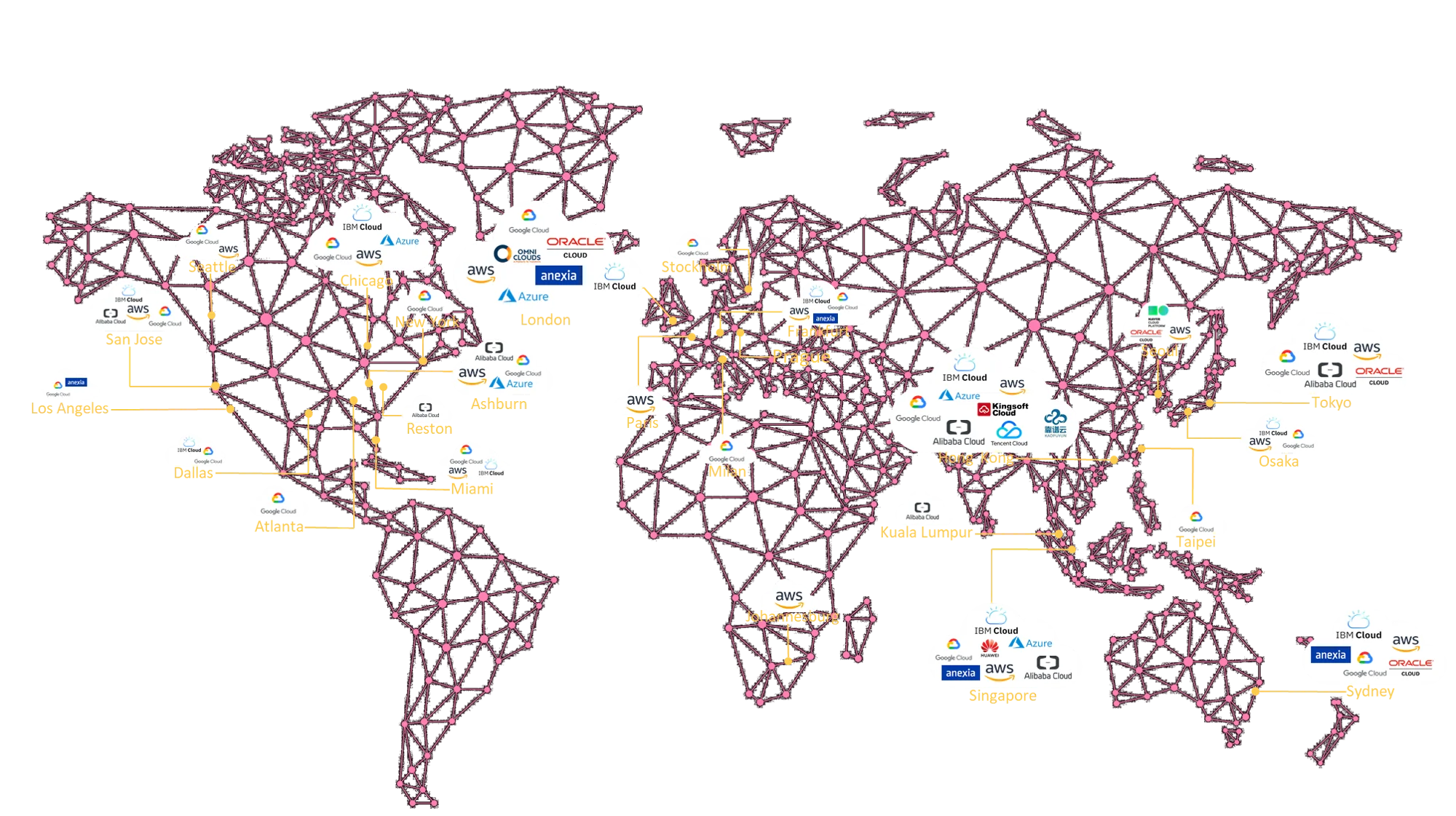
Many companies today do not rely on a single cloud provider, but diversify their cloud storage across multiple platforms — for example combining AWS S3 for backups, Microsoft Azure for business applications and Google Workspace for productivity. Each separate connection then requires its own configuration, contract and invoicing. CloudConnect solves this problem elegantly: from a single port, it connects an organisation to all public clouds worldwide, to SaaS systems and to more than 500 data centres — all under a single contract. Management is significantly simplified, costs decrease and the IT department gains the overview that multiple separate connections simply cannot provide.Hybrid-Cloud: Synchronising Private and Public Cloud
Hybrid cloud architecture — where critical company data remains in a private cloud while day-to-day working files are stored in a public cloud — is the standard in 2026 for regulated industries: banking, insurance, healthcare and public administration. CloudConnect enables synchronisation of a private cloud with a public cloud (Hybrid-Cloud) through a single console over a dedicated path outside the public internet. The result is high-performance, scalable and secure low-latency connectivity between both environments.Home Office and Remote Access: Global Coverage
One of the key features of CloudConnect — which became even more important after 2020 — is the ability to connect not only from the corporate office, but also from the homes of employees working remotely, anywhere in the world. An employee in Prague, Brno or a distant foreign country receives the same level of dedicated, secure connectivity to cloud applications.Burst Capacity Needs: Flexibility via SDN
Companies running seasonal marketing campaigns (such as Black Friday), streaming sports broadcasts or processing batch data workloads face a common problem: maintaining permanently high connection capacity just for occasional bursts is economically unviable. CloudConnect is built on its own SDN (Software-Defined Networking) platform, which enables instant and rapid changes to capacity and parameters in real time. Temporary increases in transmission capacity between partners and clouds are therefore highly flexible and cost-effective.What Are the Costs and Economics of CloudConnect?
Exact CloudConnect pricing is individual and depends on the required line capacity, geographic coverage and the number of connected cloud environments. Key economic parameters for orientation include:| Item | Parameter |
|---|---|
| Savings on egress traffic | Up to 50% compared to standard cloud provider tariffs |
| Ingress traffic | Free in all regions |
| Management | One contract, one invoice, one payment |
| Redundant connections | Individually configurable, a fraction of the cost of own infrastructure |
| Capacity changes | In real time, without hardware modifications |
| Geographic availability | All continents worldwide |
How Does CloudConnect Relate to NIS2, DORA and GDPR?
Cloud access security in 2026 is no longer purely a matter of technical architecture — it increasingly concerns legal accountability. The key regulatory frameworks with direct impact on the method of connecting to cloud services are:NIS2 — Cybersecurity Legislation
The NIS2 Directive (EU 2022/2555), transposed into Czech law, expands the scope of obligated entities and tightens requirements for security measures. Organisations from essential and important sectors (energy, transport, healthcare, banking, digital infrastructure) must demonstrate that they have implemented technical and organisational measures proportionate to the risk. Transmitting corporate data over the public internet without dedicated infrastructure may be assessed as an inadequate measure in the context of NIS2.DORA — Resilience of the Financial Sector
The DORA Regulation (EU 2022/2554 — Digital Operational Resilience Act) entered into force in January 2025 and sets out requirements for the digital operational resilience of financial institutions. It includes requirements for managing risks associated with third-party ICT providers — including the securing of connectivity to cloud environments.GDPR — Protection of Personal Data
The GDPR Regulation (EU 2016/679) requires the adoption of appropriate technical measures to protect personal data in transit. Transmitting personal data over a public internet network without additional measures may be assessed as insufficient. CloudConnect's private line, whose architecture guarantees that data does not pass through third parties, is one of the ways to provide a technical basis for meeting these requirements."The security architecture of corporate cloud connectivity must in 2026 meet not only technical standards, but also the growing legislative requirements of NIS2 and DORA. Private dedicated connectivity is one of the fundamental building blocks that make this compliance possible."
— New Telekom s.r.o. Expert Team
How Does CloudConnect Implementation Work — Step by Step?
Deploying CloudConnect does not require extensive internal IT projects. New Telekom manages the entire process from requirements analysis through to line activation. The standard procedure includes:1. Cloud Footprint and Requirements Analysis
In the first step, we map out which cloud environment the organisation currently uses or plans to use: AWS Direct Connect, Microsoft Azure ExpressRoute, Google Cloud Interconnect or private data centres. We assess the required capacity, latency and geographic coverage.2. Connectivity Architecture Design
Based on the analysis, we design the architecture: port selection, redundant paths, method of integration into the existing network (SD-WAN, MPLS, direct connection). For Multi-Cloud or Hybrid-Cloud scenarios, we design a unified solution through a single port.3. Contract Signing and Configuration
The entire solution is covered by a single contract — regardless of the number of connected clouds, data centres or geographic locations. Configuration is handled by New Telekom; the client receives access parameters and technical documentation.4. Activation and Testing
Following line activation, we conduct tests of latency, throughput and availability. Results are documented and handed over to the client as part of the commissioning protocol.5. Ongoing Management and Flexible Scaling
Through the proprietary SDN platform, line capacity can be changed in real time — without the need for physical infrastructure interventions. The customer can therefore respond to seasonal or burst capacity needs immediately.Frequently Asked Questions
What Is the Difference between CloudConnect and a Standard VPN?
A classic VPN encrypts communication but still transmits it over the public internet — that is, over third-party infrastructure that the operator cannot fully control. CloudConnect is fundamentally different: transmission takes place over New Telekom's own physical network, entirely outside the public internet. The result is higher security (data does not pass through any external nodes), lower and consistent latency, and maintained access to cloud data even during a public internet outage. For companies handling sensitive data or subject to NIS2 and GDPR, this distinction is critical.Do I Need a Separate Contract with Each Cloud Provider?
No. One of the main advantages of CloudConnect is consolidation: a single contract covers access to all public clouds (AWS, Azure, GCP and others), SaaS applications and more than 500 data centres on all continents. The IT department manages one connection, one invoice and one console — instead of dozens of separate configurations and contracts with different providers.Does CloudConnect Work for Remote Employees Working from Home?
Yes. CloudConnect is not limited to the corporate office. Access to cloud applications and data over the dedicated network is possible from employees' homes working remotely — anywhere in the Czech Republic and abroad. New Telekom is able to provide the same level of dedicated connectivity on all continents worldwide, so the geographic location of the user is irrelevant.Can CloudConnect Capacity Be Changed According to Current Needs?
Yes, and this is one of its key strengths. CloudConnect is built on its own SDN (Software-Defined Networking) platform, which enables instant changes to capacity and parameters in real time — without the need for physical infrastructure interventions. This flexibility is particularly valuable for companies with burst capacity needs (seasonal campaigns, sports broadcasts, batch data operations) that do not want to pay permanently for capacity they only use occasionally.What Is CloudConnect Availability During an Internet Outage?
CloudConnect operates independently of the state of the public internet network. Because data transmission takes place over New Telekom's own physical network, a widespread outage or attack on the public internet infrastructure has no direct impact on CloudConnect availability. An organisation therefore retains access to its strategic data and cloud applications even in situations where the public internet is unavailable. In addition, redundant connections to selected cloud provider locations can be individually configured.Which Industries Are Best Suited to CloudConnect?
CloudConnect is suitable for any organisation that stores corporate data or runs applications in cloud environments. It is particularly relevant for financial institutions subject to DORA, healthcare organisations and critical infrastructure entities under NIS2, e-commerce platforms with seasonal peaks, media companies streaming content, multinational corporations managing Multi-Cloud or Hybrid-Cloud architectures, and manufacturing enterprises using IIoT and industrial cloud platforms.Conclusion
CloudConnect represents in 2026 the answer to one of the most pressing challenges of modern enterprise IT architecture: how to securely, quickly and cost-effectively connect corporate networks to cloud environments without dependence on the public internet. MPLS VPN technology over New Telekom's own physical network, coverage of more than 500 data centres on all continents, support for Multi-Cloud and Hybrid-Cloud scenarios, flexible scaling via the SDN platform and consolidation of all management under a single contract — these are the parameters that make CloudConnect the right solution for organisations that take their cloud connectivity seriously. If your company transfers large volumes of data to the cloud, runs applications with low-latency requirements, or is looking for a way to meet the requirements of NIS2, DORA or GDPR at the network architecture level, we recommend a consultation with the New Telekom expert team. Contact us via cloudconnect.cz or reach out to our specialists.This article was prepared by the expert team of New Telekom s.r.o. Information reflects the legislative state as of March 2026.
Sources and Legislation
- Act No. 181/2014 Coll. on Cybersecurity and Amendments to Related Acts (Cybersecurity Act), as amended
- EU Directive 2022/2555 (NIS2) — on measures for a high common level of cybersecurity across the Union
- EU Regulation 2022/2554 (DORA) — on digital operational resilience for the financial sector
- EU Regulation 2016/679 (GDPR) — on the protection of natural persons with regard to the processing of personal data
- NÚKIB — National Cyber and Information Security Agency: Recommendations for Cloud Solution Security (2024)
- ČTÚ — Czech Telecommunication Office: Overview of the Data Services Market in the Czech Republic (2025)
- BEREC — Body of European Regulators for Electronic Communications: Guidelines on cloud connectivity (2025)
- IDC — European Cloud Market Report Q4 2025